

ISO 9001 and ISO/IEC 17025 Consultants for Consultancies, Engineering Firms and Testing Laboratories in UAE, Saudi Arabia & GCC
Reviewed by Nathan ISO Consulting's professional services and laboratory accreditation team, working with consultancies, engineering firms and testing and calibration laboratories across the UAE, Saudi Arabia and GCC.
A client can inspect a manufactured part. They cannot inspect a structural calculation, a soil report or a materials test result in any meaningful way, which is why professional services procurement leans so heavily on proxies — methodology, competency records, accreditation scope. For laboratories the stakes are sharper still, because a wrong result does not announce itself. It gets acted on, sometimes for years, before anyone works out where the error entered.
Nathan ISO Consulting works with engineering consultancies, testing and calibration laboratories, inspection bodies, technical and management consultancies, architectural and design firms, environmental and geotechnical specialists and surveying companies across the UAE, Saudi Arabia and the GCC.

Certification and Accreditation Are Not the Same Thing
This distinction costs laboratories money when they get it wrong, so it is worth stating precisely.
ISO 9001 certification confirms that a management system meets the standard's requirements. A certification body issues it. It says nothing about whether your test results are technically valid.
ISO/IEC 17025 accreditation is a formal attestation of technical competence to perform specific tests or calibrations, assessed by a national accreditation body against method validation, measurement uncertainty and traceability. It is granted for a defined scope — named methods, named parameters — and does not extend beyond that scope.
A laboratory holding only ISO 9001 will generally find its results rejected wherever accreditation is specified. We have seen firms invest in the wrong one and discover the gap during a tender evaluation, which is an expensive place to learn it.
Where Accreditation Assessments Focus
Accreditation assessors examine technical records directly. A polished quality manual counts for very little if the validation data behind a method is thin, which is the opposite of how many ISO 9001 audits feel and catches firms off guard.
Method validation and verification. Whether each method in scope has been demonstrated to work in your hands, on your equipment, with your staff — not merely cited from a standard.
Measurement uncertainty. Budgets are frequently calculated once during initial accreditation and never revisited, despite equipment replacement, method modification and staff turnover since.
Metrological traceability. Calibration certificates retained without verifying that the calibrating laboratory itself held appropriate accreditation and traceability to national standards. The chain breaks quietly at that link.
Competency by method. Personnel files showing general qualifications and training attendance, without documented authorisation for the specific methods each analyst performs.
Impartiality. Inspection bodies and laboratories relying on an informal understanding of conflicts of interest rather than a documented impartiality risk assessment, which is an explicit requirement.
Subcontracted work. Specialist testing passed to a subcontractor and reported onward without documented verification of that subcontractor's competence or accreditation scope.

Consultancies Have a Different Problem
Engineering and management consultancies rarely fail on technical competence. They fail on the fact that project knowledge lives in the heads of a few senior practitioners and nothing about the delivery process is repeatable or evidenced.
That works until someone leaves, a client asks how a decision was reached, or the firm bids for work requiring demonstrable quality processes. ISO 9001 in this context is less about compliance than about turning individual expertise into something the firm owns.
Standards in Scope
| Standard | Application |
|---|---|
| ISO 9001 | Project delivery, client requirements, continual improvement |
| ISO/IEC 17025 | Testing and calibration laboratory competence, basis for accreditation |
| ISO/IEC 17020 | Inspection body operation |
| ISO 27001 | Client data, project information, confidential technical documentation |
| ISO 45001 | Site-based engineers, surveyors, inspection personnel |
| ISO 14001 | Environmental management, common in sustainability-linked tenders |
| ISO 37001 | Anti-bribery, relevant for public contract bidding |
Regulatory and Licensing Context
UAE. Engineering consultancy licensing and design approval sit with municipal authorities, with the Emirates National Accreditation System handling laboratory and inspection body accreditation. Sector work may require Trakhees, Civil Defence or Estidama registration depending on scope.
Saudi Arabia. Professional licensing runs through the Saudi Council of Engineers, accreditation through the Saudi Accreditation Center, and product-related testing intersects with SASO. Aramco, SABIC and government entities apply their own prequalification requirements on top.
How We Work
Gap assessment covering method validation and technical procedures, measurement uncertainty and traceability, equipment calibration, personnel competency and authorisation, project delivery and client management, subcontractor control, impartiality and confidentiality, and internal audit readiness.
Documentation then reflects the technical work actually being performed — quality manual and technical procedures, validation records, uncertainty budgets, calibration and traceability procedures, competency and authorisation frameworks, project review procedures, and impartiality controls.
Firms holding ISO 9001 alongside ISO/IEC 17025 or 17020 share the audit, management review and corrective action machinery while keeping the technical requirements distinct and properly evidenced.
Before an Assessment
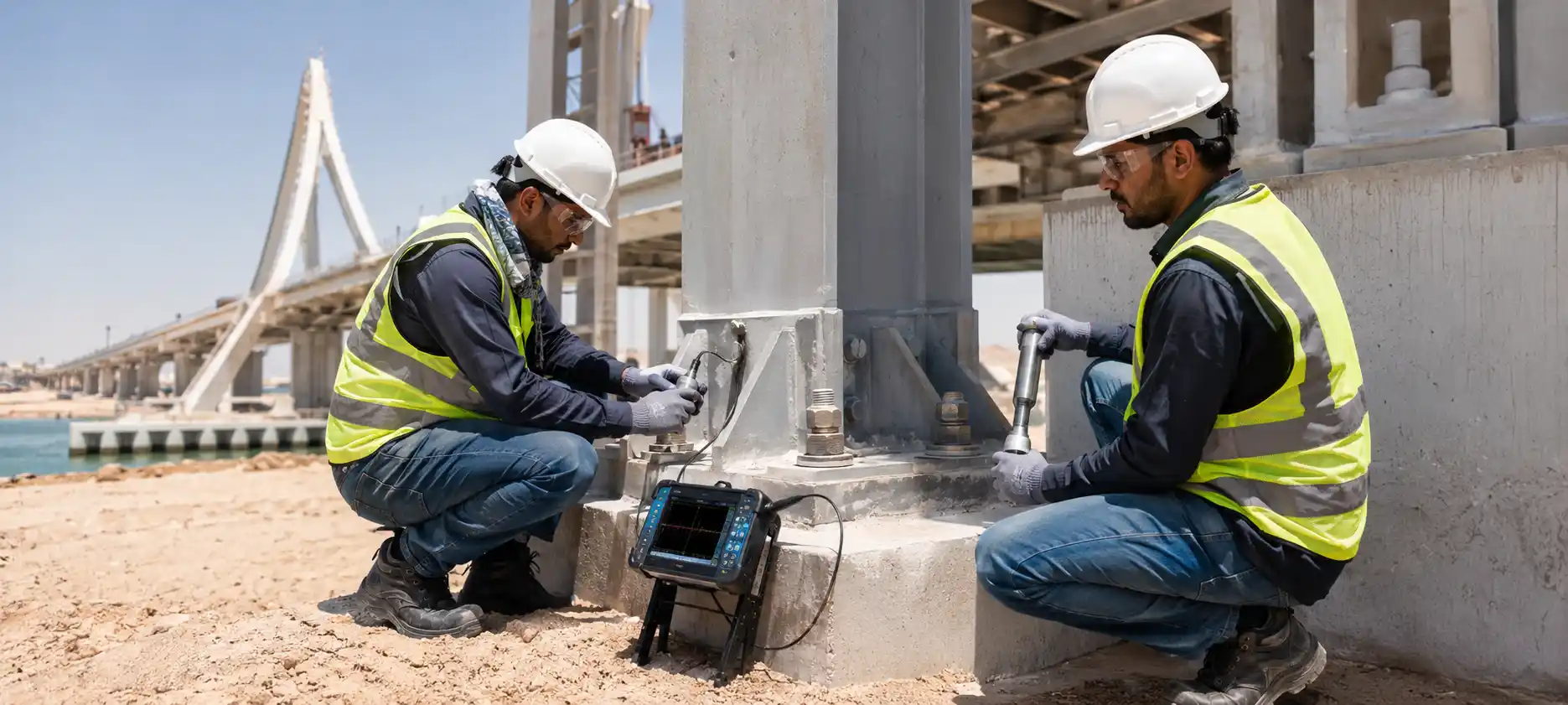
We prepare firms for initial certification or accreditation, surveillance assessments, reassessment, scope extension applications and client prequalification audits — laboratory and technical walkthroughs, validation data review, competency evidence checks, and corrective action verification.
Client Data
Consultancies and laboratories hold confidential designs, test data and commercially sensitive project information, and clients increasingly ask how it is protected before awarding work. Through VAPT Security: document management security review, laboratory information management system assessment, infrastructure penetration testing, and cloud collaboration platform review.
Training
Through NIMS: ISO/IEC 17025 internal auditor training, ISO 9001 internal auditor training, measurement uncertainty and method validation, working at height and confined space entry for field personnel, first aid, and incident investigation.
Who Owns It
In this sector the technical manager or laboratory director has to own the system, because its substance is technical practice rather than administrative procedure. A quality manager working alone will produce documentation that assessors see through immediately.
FAQ'S
Certification confirms a management system meets a standard. Accreditation, as under ISO/IEC 17025, attests to technical competence for specific tests or calibrations, assessed by a national accreditation body.
Yes, and many do. ISO 9001 covers the broader business while ISO/IEC 17025 addresses technical competence for the accredited scope.
Typically six to fifteen months, depending on how many methods are in scope, the maturity of validation data and proficiency testing history.
It depends on site exposure and client requirements. Firms whose staff regularly attend active construction or industrial sites often need it, and principal contractors frequently require it.
Yes. Laboratories commonly start with core methods and extend, which requires validation data and assessment for each addition.
The management system elements largely carry over. The new work is technical: method validation, uncertainty budgets, traceability and method-specific competency records.
Coverage
Engineering consultancies in Dubai, materials testing laboratories in Abu Dhabi, calibration laboratories in Sharjah, inspection bodies in Riyadh and technical firms throughout the GCC. Services cover ISO 9001, ISO/IEC 17025, ISO/IEC 17020, ISO 27001, ISO 45001 and integrated management system implementation.


0
Projects

0
Services

0
Clients Serving

0
Countries Serving