

ISO 45001 and ISO 14001 Consultants for Mining, Quarrying and Aggregate Companies in UAE, Saudi Arabia & GCC
Reviewed by Nathan ISO Consulting's extractive industries QHSE team, working with quarry operators, mining companies and aggregate processors across the UAE, Saudi Arabia and GCC.
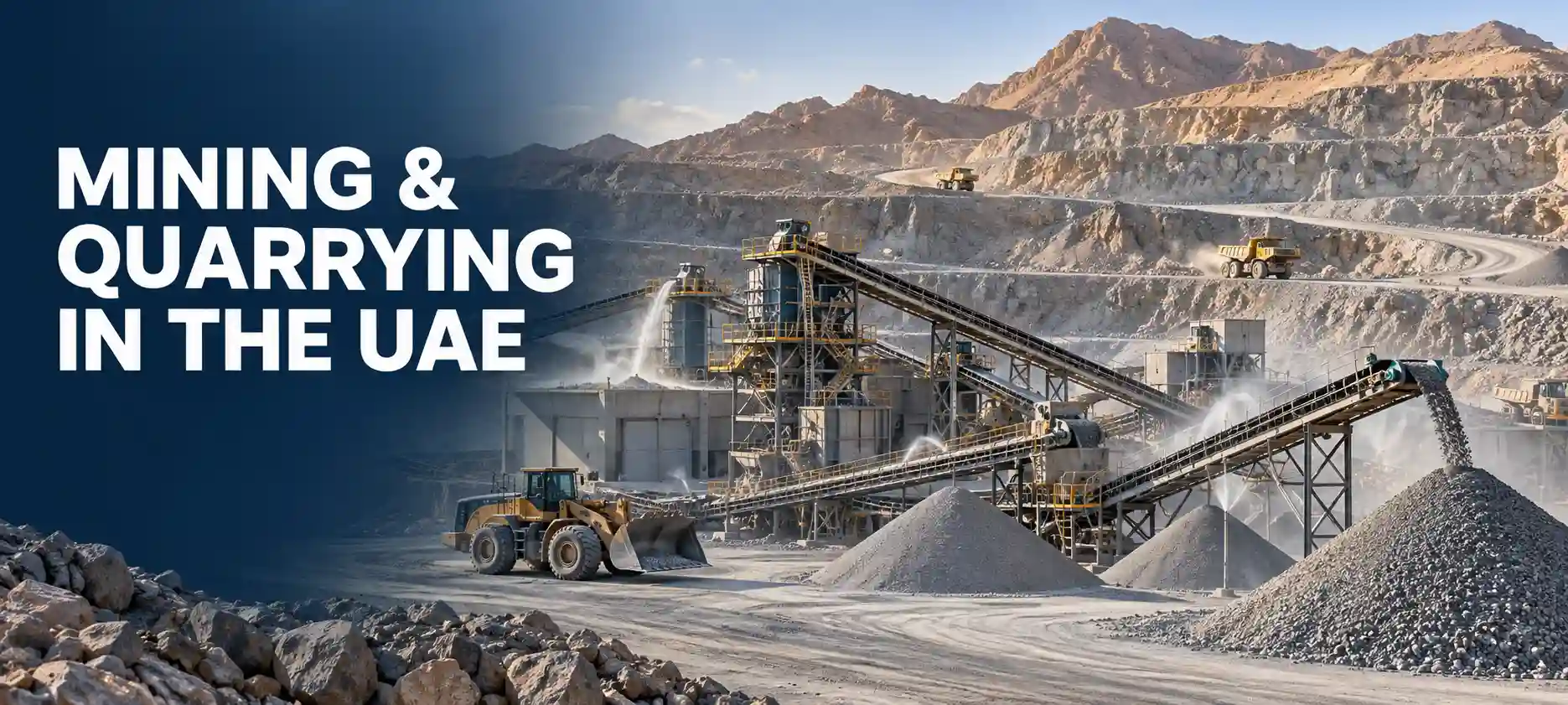
Extraction is among the few industries where the workplace itself changes shape every day. A quarry face that was stable last month is not the same face after this month's blasting, and a management system written around fixed installations does not transfer well to ground that moves.
Nathan ISO Consulting works with quarry and aggregate operators, mining and mineral extraction companies, crushing and screening operations, cement and lime producers, drilling and blasting contractors, and mineral processing and export operations across the UAE, Saudi Arabia and the GCC.
Why This Sector Sits Differently
Most industrial certification work concerns processes that repeat identically. Extraction concerns processes that repeat in changing conditions, which shifts the emphasis of the entire system.
Risk assessment cannot be a document reviewed annually. Ground conditions, bench geometry, water ingress and equipment positioning change continuously, and the assessment that matters is the one performed before the shift rather than the one filed last January. Systems that fail in this sector usually fail because they were designed around annual review cycles borrowed from manufacturing.
The Regional Picture
UAE. Quarrying is concentrated in the northern emirates, particularly Ras Al Khaimah and Fujairah, supplying aggregate to construction across the region and for export. Operators engage with emirate-level authorities for quarrying permits, alongside Ministry of Energy and Infrastructure requirements, environmental authorities on dust and blasting impact, and Civil Defence for explosives storage where applicable.
Saudi Arabia. Mining has become a declared third pillar of the industrial economy under Vision 2030, with the Ministry of Industry and Mineral Resources administering exploration and exploitation licensing through the mining investment framework, and the National Center for Environmental Compliance governing environmental performance. Ma'aden and its joint ventures set supply chain expectations that reach well down the contractor base.
Certification does not substitute for licensing or environmental permitting. What it provides is the structure that makes permit conditions verifiable across shifts and contractors, which matters particularly on sites where much of the workforce is subcontracted.
Standards
| Standard | Application |
|---|---|
| ISO 45001 | Ground stability, blasting, mobile plant, silica dust, noise and vibration |
| ISO 14001 | Dust, water management, land disturbance, rehabilitation, waste rock |
| ISO 9001 | Product specification consistency, aggregate grading, customer requirements |
| ISO 50001 | Energy management for crushing, screening and processing plant |
| ISO 55001 | Lifecycle management of mobile plant, crushers and fixed infrastructure |
| ISO 22301 | Continuity for equipment failure, permit interruption and supply disruption |
| ISO 14064 | Greenhouse gas quantification, increasingly requested by cement and export customers |
The core is almost always ISO 45001 and ISO 14001, with ISO 9001 added where product specification matters to customers — which for aggregate supplied into concrete production, it very much does.
What Site Reviews Find
Risk assessments that describe last year's face. Ground and bench assessments completed at permit stage and reviewed annually, while the actual working face has advanced two hundred metres into different geology.
Blasting controls strong, post-blast inspection weak. Charge design, exclusion zones and initiation procedures handled rigorously, with far less structure around post-blast face inspection, misfire procedures and re-entry authorisation.
Silica exposure unmeasured. Respirable crystalline silica treated as a general dust issue rather than monitored as a specific occupational exposure, despite being the sector's most significant long-term health hazard.
Mobile plant interaction managed informally. Haul truck, excavator and light vehicle interaction controlled by custom and radio discipline rather than documented traffic management, which holds until a new operator or contractor arrives.
Subcontractor systems assumed equivalent. Drilling, blasting and haulage contractors engaged without verifying that their own safety systems and competency records meet the site standard they are working under.
Rehabilitation obligations deferred and unquantified. Progressive rehabilitation commitments in the permit acknowledged but not planned, funded or tracked, accumulating as a liability nobody has costed.
Water management designed for a rainfall pattern that has changed. Sediment control and dewatering arrangements sized against historic assumptions, tested only when an unusual event exceeds them.
How We Work
Gap assessment across ground control and geotechnical management, blasting and explosives handling, mobile plant and traffic management, dust and silica exposure control, noise and vibration, water and sediment management, rehabilitation planning, subcontractor control, and product quality where specification applies.
Documentation is built for a site rather than an office — shift-level risk assessment formats that supervisors will actually complete, blasting and post-blast procedures, traffic management plans, exposure monitoring procedures, environmental monitoring and rehabilitation plans, contractor approval and verification, and incident investigation.
Extraction operations running ISO 45001 and ISO 14001 separately gain a great deal from integration, since dust, water and ground control sit on both sides of that boundary and splitting them produces duplicated assessment.
Regulatory and Customer Audits
We prepare operators for certification audits, surveillance visits, recertification, regulatory and permit inspections, and customer audits from cement producers, contractors and export buyers — site and face walkthroughs, blasting and exposure record review, environmental monitoring review, contractor verification, and corrective action closure.
Permit inspection or customer audit approaching? Request an independent readiness review first.
Site Systems and Remote Operations
Modern extraction sites run fleet management systems, remote monitoring on fixed plant and increasingly automated crushing and screening control. Sites are often remote, connectivity is frequently improvised, and vendor remote access tends to be permanent. Through VAPT Security: fleet management and telematics assessment, plant control and automation security review, remote access and connectivity review, and infrastructure penetration testing.
Training
Through NIMS: working at height and edge protection, confined space entry, mobile plant and haul road safety, silica and dust awareness, noise and hearing conservation, LOTO and permit-to-work, first aid and emergency response for remote sites, and incident investigation.
Who Needs to Be Involved
The quarry or mine manager owns the system in practice, because the decisions that matter — where to work the face, when to blast, when to stop — are theirs. Alongside them the geotechnical or technical services lead, blasting supervisor, plant and maintenance manager, QHSE manager, environmental officer and the contracts function managing subcontractors.
FAQ'S
Permits and licences are the mandatory requirement and vary by emirate. Certification is voluntary but increasingly expected by cement producers, major contractors and export customers as a supply condition.
ISO 45001 and ISO 14001 in almost all cases, integrated. ISO 9001 follows where aggregate specification and grading consistency matter to customers, which is common for material going into concrete.
Blasting is addressed through the standard's hazard identification and operational control requirements rather than by a dedicated clause. The system has to demonstrate that charge design, exclusion, initiation, post-blast inspection and misfire handling are controlled and competent.
ISO 14001 requires that compliance obligations, including permit rehabilitation conditions, are identified and planned for. It does not set the obligation itself, which comes from the licence or permit.
As a specific occupational health hazard with exposure monitoring, health surveillance where required, and defined controls, rather than as part of general dust management. Auditors increasingly ask for exposure data rather than dust suppression procedures alone.
Work performed under your control on your site falls within your management system's scope. That means verifying contractor competency, equipment and safe systems of work rather than relying on their own certification alone.
It can where the mobile fleet and fixed plant represent significant capital and availability drives output. Crushers, screens and haul fleets benefit from lifecycle planning in the same way generation assets do.
A structured method for quantifying and reporting greenhouse gas emissions. It is increasingly requested by cement customers and export buyers responding to their own reporting obligations.
Yes, through a multi-site scope, provided the management system is genuinely common and each site is sampled during audit. Sites operating under materially different conditions sometimes certify separately.
The management system structure carries over. The substantive new work is hazard identification, risk assessment at the operational level, worker consultation, incident investigation and emergency preparedness, which for extraction is where the real content sits.
Coverage
Quarry and aggregate operators across Ras Al Khaimah, Fujairah and the northern emirates, processing and export operations in the UAE, and mining and mineral companies across Saudi Arabia including Riyadh, Jubail and regional mining districts, plus Oman, Qatar, Bahrain and Kuwait. Services cover ISO 45001, ISO 14001, ISO 9001, ISO 50001, ISO 55001 and integrated management system implementation.
Request a Mining and Quarrying Gap Assessment and find out whether your risk assessments describe the face you are actually working.


0
Projects

0
Services

0
Clients Serving

0
Countries Serving