

ISO 9001, ISO 14001 and ISO 45001 Consultants for Manufacturing and Industrial Companies in UAE, Saudi Arabia & GCC
Reviewed by Nathan ISO Consulting's manufacturing QHSE team, working with factories, industrial producers and automotive suppliers across the UAE, Saudi Arabia and GCC.
Manufacturing is the one sector where a management system pays for itself before the certificate arrives. A process out of control shows up as scrap, rework and warranty claims within weeks, not years, which means the improvement work has a measurable return long before an auditor sets foot on site.
Nathan ISO Consulting works with metal fabrication and steel producers, plastics and packaging manufacturers, building materials and cement producers, electrical and electronics manufacturers, automotive component suppliers, furniture and consumer goods factories and heavy industrial producers across the UAE, Saudi Arabia and the GCC.
Why Certification Became a Condition of Supply
Industrial policy across the Gulf turned decisively toward local manufacturing — UAE Operation 300bn, Saudi Arabia's National Industrial Development and Logistics Programme — and factory investment followed. What arrived alongside it was a more demanding class of buyer. Government offtakers, large contractors and export customers make certification a supply condition rather than a preference, and a factory without it is filtered out before anyone evaluates its capability.
What We Find on Shop Floors
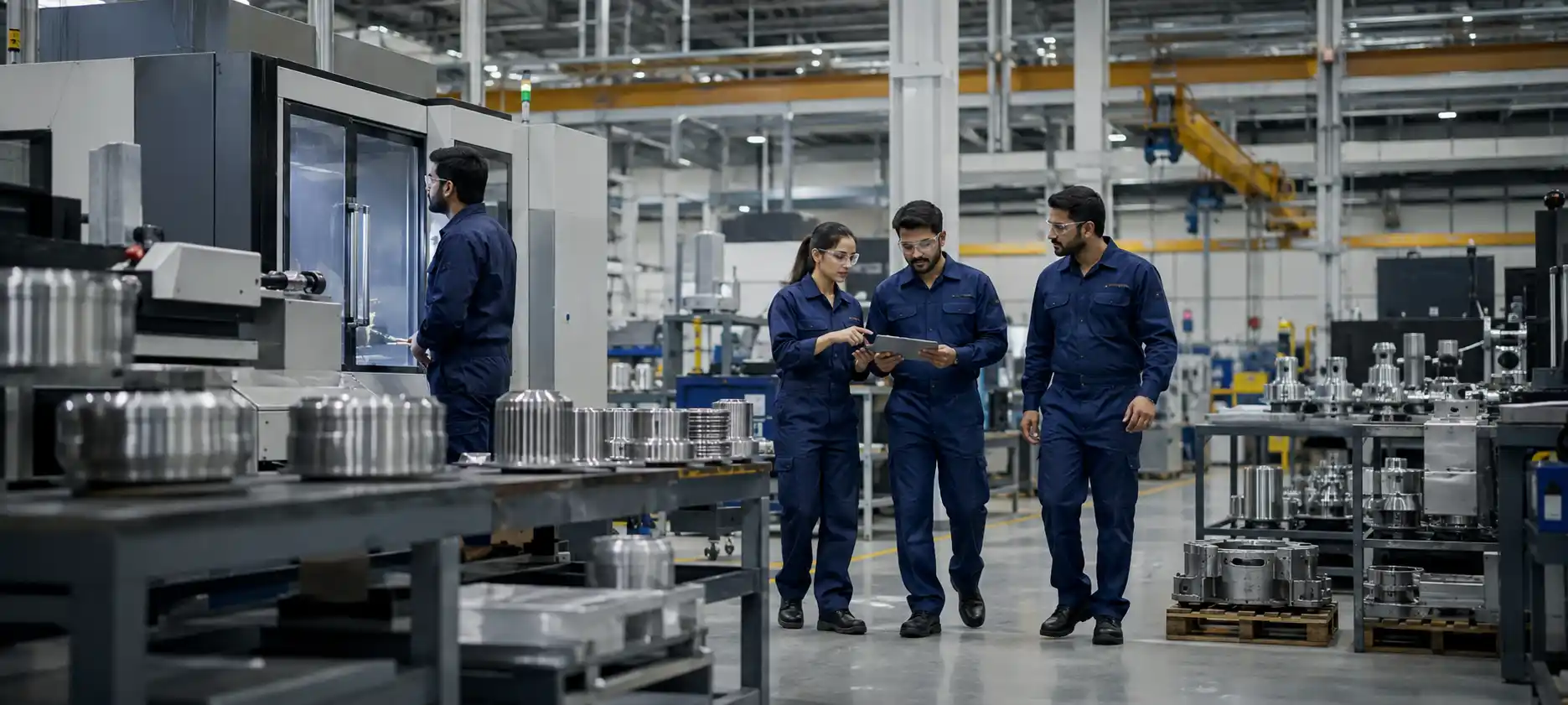
Parameters that drift between shifts. Experienced operators adjusting machine settings informally, producing shift-to-shift variation that appears nowhere in the documented process controls. Nobody is doing anything wrong by their own understanding, which is what makes it persistent.
Fixtures excluded from calibration. Measuring instruments calibrated on schedule while the jigs, fixtures and gauges used for in-process checks are never included in the programme.
Weak physical segregation. Nonconforming material identified and recorded but stored where it can be pulled back into production during a busy shift. The record says quarantined; the shop floor says otherwise.
Root cause that stops at the operator. Investigations concluding with operator error rather than examining the process, training or equipment conditions that permitted it. The finding closes and the failure repeats.
Guards removed and not replaced. Machine guarding and interlocks removed during maintenance and left off or bypassed afterwards. Among the most common serious findings in industrial safety auditing, and among the most consequential.
Supplier quality by inspection alone. Suppliers managed through incoming inspection rather than performance monitoring and development, which catches defects without ever reducing them.
Standards
| Standard | Application |
|---|---|
| ISO 9001 | Process control, nonconformity handling, continual improvement |
| ISO 14001 | Emissions, effluent, industrial waste, resource consumption |
| ISO 45001 | Machine safety, chemical exposure, industrial workplace risk |
| IATF 16949 | Automotive supply chain requirements |
| ISO 50001 | Energy management for energy-intensive processes |
| ISO 55001 | Lifecycle management of production plant and machinery |
| ISO 27001 | Production data, design information, industrial control systems |
IATF 16949 and Who Actually Needs It
IATF 16949 applies to organisations in automotive production and service part supply chains. Where an automotive customer requires it, it functions as a condition of entry rather than a differentiator, and there is no alternative route.
Where no automotive customer is involved, it adds considerable cost for no commercial return. A building materials producer, a food packaging manufacturer or a furniture factory is served by ISO 9001. We mention this because manufacturers are sometimes sold IATF 16949 on the argument that it demonstrates superior quality, which is true in a narrow sense and irrelevant if no buyer is asking for it.
Implementation, where it is warranted, covers advanced product quality planning and production part approval, FMEA discipline, statistical process control and capability studies, measurement system analysis, supplier development and sub-tier management, control plans and process flow documentation, and customer-specific requirements.
Regulatory Context
UAE. Industrial licensing and the National In-Country Value programme run through the Ministry of Industry and Advanced Technology, with ESMA and Emirates Conformity Assessment Scheme requirements for regulated products, Civil Defence approvals for industrial premises, and municipal or Environment Agency requirements for emissions and waste.
Saudi Arabia. Industrial licensing sits with the Ministry of Industry and Mineral Resources, product conformity with SASO and SABER, local content certification with LCGPA, and environmental permitting with the National Center for Environmental Compliance.
How We Work
Gap assessment across process control and parameter management, inspection, testing and calibration, nonconforming product control and traceability, machine safety and guarding, chemical handling, emissions and waste, supplier quality, and maintenance and equipment reliability.
Documentation is written to be used at the machine — quality manual and process procedures, control plans and process flow, inspection and test procedures, calibration and maintenance schedules, machine safety and LOTO procedures, nonconforming product and corrective action, and supplier evaluation and development.
Integration is nearly always worthwhile in a factory. The same production management team carries quality, environmental and safety accountability on the same shop floor, and three separate audit cycles produce fatigue rather than assurance.
Audit Preparation
We prepare manufacturers for certification audits, surveillance visits, recertification, customer audits and regulatory inspection — shop floor and production line walkthroughs, quality record and traceability review, machine safety and permit evidence review, and corrective action verification. For many manufacturers the customer audit is the harder one, since second-party auditors know the product and ask sharper questions.

Industrial Control System Security
Factories run PLCs, SCADA and networked production equipment that were mostly installed without any security review. A compromise stops production or corrupts the quality records a customer complaint would rely on. Through VAPT Security: PLC and SCADA assessment, OT network segmentation review, manufacturing execution system testing, and infrastructure penetration testing.
Training
Through NIMS: machine safety and guarding, LOTO and permit-to-work, chemical handling, forklift safety, working at height, fire safety and emergency response, first aid, and incident investigation and root cause analysis.
Supervisors Decide Whether It Works
Production supervisors make the daily decisions the system is meant to standardise. Leaving them out of the project produces procedures that describe a factory nobody recognises. The plant manager, production manager, quality manager, maintenance and engineering manager, QHSE manager and procurement manager all need to be involved, but the supervisors are the ones who determine whether any of it holds.
FAQ'S
No. Industrial licensing and product conformity are mandatory; ISO 9001 is voluntary. Many government offtakers, contractors and export customers require it contractually, which makes it a practical necessity.
Automotive-specific requirements including advanced product quality planning, production part approval, statistical process control and customer-specific requirements. It applies only within automotive supply chains.
Usually yes. They share a common structure, allowing one risk assessment, internal audit, corrective action and management review process instead of three.
Indirectly. It supports the quality and capability evidence these programmes assess, though ICV and local content certification follow separate methodologies and audits.
ISO 50001 provides structure for monitoring, targeting and reducing consumption, which is often worthwhile for smelting, cement production or plastics extrusion.
Common additions are ISO 14001 and ISO 45001, integrated into the existing system, plus internal audits, surveillance preparation and closing recurring nonconformities.
Coverage
Steel fabrication in Dubai Industrial City, plastics factories in Sharjah, building materials in Ajman, automotive component suppliers in Dammam, and industrial operations across Riyadh, Jubail, Oman, Qatar, Bahrain and Kuwait. Services cover ISO 9001, ISO 14001, ISO 45001, IATF 16949, ISO 50001, ISO 55001 and integrated management system implementation.


0
Projects

0
Services

0
Clients Serving

0
Countries Serving